Market Entry

How to lower your U.S. tariff bill and stay compliant: 4 strategies for EU exporters

Carmen Muñoz-Vicedo

VP Business Development TABS

Oct 18, 2026

5 minutes

U.S. tariffs have become "predictably unpredictable." They aren't going away, but nobody knows where they will land next. For European exporters, that makes landed cost calculations harder every quarter. With U.S. customs enforcement getting stricter, compliance mistakes are riskier than ever. However, despite these challenges, the U.S. remains an indispensable market that continues to attract many European brands. 

You can reduce your duty bill and stay fully compliant. In our recent webinar with customs specialists Alongsight, we covered the strategies that are working for their clients today. Every strategy relies on documentation, transparency, and a solid understanding of customs rules. Here is what you need to know.

The tariff picture in 2026

The rules as of September 2026 sit on three layers:

1.
Global tariffs:
The IEEPA tariffs from "Liberation Day" were struck down by the Supreme Court in February 2026. They were replaced first by a temporary 10% Section 122 surcharge, then by Section 301 "forced labor" tariffs covering 60 countries, including the EU. The EU currently has a 10% ceiling.
2.
Country-specific tariffs:
China remains the outlier, and new measures now target Brazil and Canada.
3.
Product-specific (Section 232) tariffs:
These hit metals, cars and parts, timber, trucks, patented pharmaceuticals, and more. Metals are hit hardest, at 44–47% for iron, steel, and aluminum.

According to the Yale Budget Lab, the average U.S. tariff rate is now around 11%, compared with 1.23% before 2025.

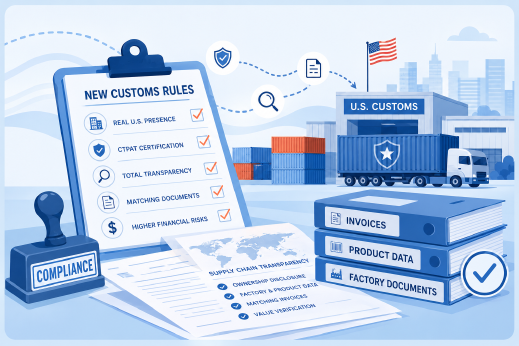
Tariffs are also only half the story. Enforcement is getting stricter for importers of record. Read our full breakdown of the Strengthening Customs Enforcement executive order.

Start with the customs basics

Classification: A wrong commodity code means a wrong duty rate, delays in the supply chain and penalties.
Origin: Rates now depend on where your goods come from. Shipping Chinese goods through the EU does not make them EU origin.
Valuation: This is the amount your duty rate is applied to, and where the biggest savings often are.

Alongsight's advice is to master these three pillars first, because they cover the vast majority of the opportunity.

Strategy 1: The first sale rule

If your goods pass through a chain of sales before reaching the U.S., you may be able to declare the first sale (manufacturer to middleman) as your customs value, instead of the last one (middleman to U.S. buyer). The tariff rate stays the same, but the value it applies to is lower.

For instance, an item valued at $10 in the initial transaction and $20 in the subsequent sale would see its 15% customs assessment calculated against the initial transaction or “first sale”, cutting the assessment from $3.00 down to $1.50 per item.

To qualify, the first sale must be:

Bona fide: The middleman really bought the goods and took ownership and risk.
Destined for the U.S.: Shown through U.S.-specific products or matching purchase orders.
At arm's length: Intercompany pricing must meet fair market value standards.

The most common reason for U.S. Customs and Border Protection (CBP) to reject First Sale claims is insufficient documentation. Maintaining a bulletproof, audit-ready defense file is mandatory.

Strategy 2: Valuation unbundling

When one bundled price covers goods, engineering, management fees, and IT services, the whole amount can become dutiable. Separating what is genuinely non-dutiable can lower your duty bill.

For example, a $100 bundled unit at 15% duty costs $15. Split into $65 for goods and $35 for services, the duty falls to $9.75. That is a 35% saving. 

Three tips:

1.
Invoice services separately:
Management fees, IT services, warranties, and training may be excluded if properly documented.
2.
Involve customs in your license agreements:
CBP assumes royalties are dutiable, so your contracts should support their exclusion where possible.
3.
Itemize freight and insurance:
The U.S. uses FOB value, unlike the EU's CIF. Clearly separated freight and insurance costs can be excluded. Alongsight has seen savings of around €1 million in duties for multinationals from this alone.

Keep in mind that only truly non-dutiable costs can be unbundled, and each one needs proper documentation and separate invoicing to stand up to CBP's scrutiny. Royalties paid as a condition of sale, for example, still count.

Strategy 3: Exemptions and lower rates

There are three types of relief to keep an eye on:
1.
Exemptions specific to the new tariffs, such as certain raw materials, agricultural products, aerospace goods, high-tech products, and pharmaceuticals.
2.
Existing Chapter 98 exemptions, such as goods returned after repair, where you typically pay duty only on the value added.
3.
Lower rates for certain countries, such as EU cars and car parts. This relies on proving the correct origin.

Classification and a good understanding of your product and its end use are key. One Alongsight client in the agricultural sector brought its duty burden down to 0%.

Strategy 4: IEEPA refunds

The Supreme Court struck down the IEEPA tariffs, and lower courts found that the duties must be repaid. CBP has launched CAPE, a module in its ACE platform, so importers can file refund claims.

Here is what to know:

Current scope: Entries not yet liquidated, or liquidated less than 80 days ago. This window will close.
How it works: Submit a list of entry summary numbers. Repayment should follow within 60 to 90 days of acceptance.
Common hurdles: ACE account setup, broker communication, and CBP helpdesk backlogs.
Uncertainty: The administration's appeal may affect other entries.

How TABS keeps your business moving

Lowering your duty bill is one part of a compliant U.S. import setup. TABS helps European companies build the foundation behind it:

Compliant U.S. structure: We manage your U.S. Entity Setup & Governance.
Real U.S. presence: We provide a physical address and back-office support through U.S. Presence & Office.
Vetted experts: We connect you with our trusted network of logistics companies and licensed customs brokers, and with specialists like Alongsight for classification, origin, valuation, and refunds.

Summary

To succeed and maintain profitability in the U.S. market, European exporters must align three core operational pillars:

1.
Entity & corporate structure:
Establishing and managing a legitimate U.S. subsidiary to satisfy Importer of Record (IOR) rules, streamline transfer pricing, and ensure proper corporate governance.
2.
Customs valuation & duty optimization:
Utilizing the first sale rule, valuation unbundling, accurate HS classification, and statutory exemptions to lower total landed costs and protect gross margins.
3.
Documentary traceability & compliance:
Maintaining audit-proof defense files, a verified U.S. physical presence, and traceable origin documentation to meet heightened U.S. Customs (CBP) enforcement standards.

TABS provides seamless back-office services to ensure your U.S. operations are fully compliant, cost-effective, and structured for long-term growth.

Contact TABS today for a full review of your import setup to ensure your business stays compliant and protected.

About Alongsight

Established in Belgium in 2024, Alongsight delivers specialized legal and tax advice to help companies lower tax liabilities and drive innovation. Operating under the ethos "When others hesitate, we deliver," the firm assists clients in unlocking significant R&D tax savings while navigating complex audits. Alongsight also offers dedicated transfer pricing expertise, guiding multinational businesses through policy implementation, intercompany benchmarking, dispute resolution, and APAs. 

Disclaimer: This article is for general informational purposes only and reflects the regulatory landscape and tariff rates as of September 30, 2026. U.S. trade policy is evolving quickly, and rates, exemptions, deadlines, and legal proceedings (including the IEEPA refund process) may have changed since publication. It does not constitute legal, tax, or customs advice. Please consult a qualified professional before making decisions based on this content.

Explore more insights

Related articles you might find useful
HR & Payroll
Blog_US_immigration_enforcement_Laura

Stricter U.S. immigration enforcement: Managing immigration, tax and employment risks

By Laura Hoogendoorn
For international companies expanding to the U.S., real regulatory challenges begin the moment team members step onto U.S. soil to conduct business, or they hire locally. While historically the focus has been on market entry and customer acquisition, a shift in operational priorities may be needed ensure the mitigation of immigration, tax and employment liabilities.
Read Article
3 minutes
Market Entry
blog_june_15th

What the "Strengthening Customs Enforcement" executive order means for international entities

Jun 15, 2026
By Carmen Muñoz-Vicedo
The new 'Strengthening Customs Enforcement' Executive Order fundamentally rewrites the rules for Importers of Record. If your business imports goods into the U.S., the old way of doing business is officially over. Here is what you must do to stay compliant.
Read Article
4 minutes